


Healthcare Quarterly, 29(Special Issue) November 2026: 5-10.doi:10.12927/hcq.2026.27970
Introduction
Improving Equity in Access to Palliative Care for Communities Experiencing Homelessness or Vulnerable Housing
Improving Equity in Access to Palliative Care Program Delivery Team (including* Clarissa Chan, Andrea Coronado, Kristen DeCaria Emilie Desmottes, Amber Heyd, Mihaela Labbe, Kirstin Loates, Tanya MacDonald, Nicole Robinson, Raquel Shaw Moxam and Lindsay Yarrow)


Abstract
Supporting progress toward the objectives of the Framework on Palliative Care in Canada, Healthcare Excellence Canada (HEC) and the Canadian Partnership Against Cancer (the Partnership) launched the Improving Equity in Access to Palliative Care (IEAPC) collaborative in 2022, bringing together people from health and social care sectors across the country to design, deliver and evaluate initiatives that drive measurable improvement in access to equity-oriented palliative care for people experiencing homelessness or vulnerable housing. This introductory article outlines the purpose of this special issue of Healthcare Quarterly, the IEAPC collaborative and the gaps in palliative care in Canada for individuals experiencing homelessness or vulnerable housing. As we look toward a future where everyone in Canada has access to safe and high-quality care, we hope this special issue will be a source of inspiration and encouragement for leaders across the healthcare system to improve equity in palliative care.
Key Takeaways
- The Framework on Palliative Care in Canada recognizes the need to address gaps in access to and quality of palliative care for underserved populations, including people experiencing homelessness.
- Improving Equity in Access to Palliative Care brought together 23 communities across eight provinces to improve access to palliative care for people experiencing homelessness or vulnerable housing.
- This special issue shares impacts and insights from leading innovative models of equity-oriented palliative care for people experiencing homelessness, highlighting key considerations for design, implementation and evaluation for potential spread and scale.
Introduction and Impetus
Improving access to high-quality palliative care at end of life continues to be a priority across Canada (Health Canada 2023). Palliative care aims to reduce suffering and improve the quality of life for people and their families throughout the course of their serious illness (e.g., cancer, dementia, organ failure and neurological diseases) (Cancer Care Ontario 2014; WHO 2020). Of those who died in Canada between 2021 and 2022, 58% received palliative care with only 36% having access to palliative home care (CIHI 2023). Lack of access to home and community-based palliative care supports can lead to increased emergency department use (CIHI 2023), putting additional strain on the healthcare system (Haas et al. 2023). While the number of people who were able to die at home with palliative home care has increased by 7% since 2016–2017 (CIHI 2023), access to palliative care at the end of life for people experiencing homelessness or vulnerable housing is often overlooked, with significant barriers impeding the ability for this population to die with dignity in the environment of their choice (Stajduhar et al. 2024).
Many palliative care services are often not designed for, nor do they address the social, structural and economic inequities that significantly impact health, illness and dying. People experiencing homelessness or vulnerable housing are significantly less likely to have access to palliative care services, further exacerbating the challenges they may experience in achieving dignity and comfort at the end of life (Stajduhar et al. 2019, 2024; Stajduhar and Gott 2023). Homelessness describes the situation of an individual, family or community without stable, permanent, appropriate housing, or the immediate prospect, means and ability of acquiring it (Canadian Observatory on Homelessness 2012). It is estimated that about 235,000 people in Canada experience homelessness each year (Gaetz et al. 2014).
Policy Context
Gaps in access to and quality of palliative care for underserved populations, including people experiencing homelessness and vulnerable housing, were recognized across Canada with the publication of a Framework on Palliative Care in Canada (Health Canada 2018). The Framework was intended to provide a collective vision of palliative care access for all people living with serious illness in Canada to live well until the end of life. Given the complex nature of the healthcare system, the Framework identified four priority areas for action (Box 1).
| BOX 1. Framework for palliative care in Canada – goals and priorities |
|
To complement the Framework, a Federal Action Plan on Palliative Care was developed in 2019 and outlined a five-year plan focused on improving quality of life for people living with life-limiting illness, families and caregivers and enhancing access, quality of care and healthcare system performance (Health Canada 2019). The Action Plan clarified the steps needed to achieve the vision set out in the Framework. One of the key goals and actions was to foster improved access to palliative care for underserved populations – including those experiencing homelessness or vulnerable housing.
In the Context of Structural Vulnerability and Homelessness
Our health outcomes and ability to access healthcare are deeply influenced by where we live, work and learn. The population of those experiencing homelessness or vulnerable housing is diverse in nature. It encompasses a range of intersecting demographics, including race and ethnicity, mental health status, age and gender and the social forces that shape who becomes and remains unhoused or vulnerably housed. The concept of structural vulnerability is often used to describe this diverse population to redirect our attention to systemic and structural factors that produce and maintain inequities (Stajduhar and Mollison 2018).
Persistent obstacles to accessing timely and high-quality care contribute to the exacerbation of health conditions, leading to a significant reduction in life expectancy among those experiencing homelessness (Roerig et al. 2024). For instance, people experiencing homelessness are 29 times more likely to have hepatitis C, five times more likely to have heart disease and four times more likely to develop cancer (St. Michael's Hospital 2017). In Toronto, the median age of death for people experiencing homelessness was 50 years of age compared to the general population whose median age of death was 82 (Toronto Public Health 2025).
Currently, care systems overlook many barriers that impact an individual's ability to navigate and receive care, including transportation, psychosocial support, food and shelter (Box 2). Overcoming these barriers also involves the navigation of multiple siloed systems, where the lack of continuity can ultimately result in individuals falling through gaps in care and not receiving the help they need (Stajduhar and Mollison 2018). A focus on securing needs for survival also makes it difficult to seek care. As such, awareness and provision of available palliative care, including advance care planning and discussions about death, often never occur (Stajduhar et al. 2019). For those who are identified for palliative care, this often occurs at late disease stages, once dying has already begun (Stajduhar and Mollison 2018). Furthermore, individuals who are homeless or vulnerably housed often have fewer social supports and have been observed to pass away alone in acute care, shelters, transitional housing or other areas away from family, friends and care workers in their communities (Stajduhar and Mollison 2018; Stajduhar et al. 2019).
| BOX 2. Barriers to care |
| The most common barrier raised by participants was the cost of transportation to and from their many appointments. Without access to vehicles and friends who had vehicles and could drive them, participants relied on public transportation. The farther they had to go, the more it cost. The challenge of public transportation was exacerbated as people became sicker and their health and mobility declined (Stajduhar et al. 2019). |
Overview of the Improving Equity in Access to Palliative Care Collaborative
As two Pan-Canadian Health Organizations with a history of partnership, collaboration and impact, Healthcare Excellence Canada (HEC) and the Canadian Partnership Against Cancer (the Partnership), were well positioned to respond to the Federal Action Plan on Palliative Care (Health Canada 2019). In 2022, HEC and the Partnership embarked upon a four-year journey bringing together people from health and social care sectors across the country to design, deliver and evaluate initiatives that drive measurable improvement in access to palliative care for people experiencing homelessness or vulnerable housing through the Improving Equity in Access to Palliative Care (IEAPC) collaborative (HEC n.d.). IEAPC was thoughtfully co-designed with subject matter experts including patients; caregivers; First Nations and Métis advisors, Elders and coaches; and a steering committee who provided advice and guidance to the Program Delivery Team. The relational approach of the collaborative focused on building capacity, building partnerships through learning and growth while sustaining impact.
With over $2.2 million in seed funding from Health Canada, communities across Canada were invited to participate in the collaborative through an application process. Reflecting the values of the collaborative, the applications were reviewed by a diverse panel including people with lived and living experience; researchers; First Nations, Inuit and Métis Elders; health and social care providers; and policy makers.
The assessment of applications considered:
- readiness, evidence of meaningful engagement;
- adequate consideration of the structural determinants of health;
- commitment to equity;
- diversity in team representation;
- clarity in population and potential patient reach; and
- potential for spread.
The first call for applications was launched in 2022 with 10 communities (Cohort 1) selected. The first phase of the program focused on identifying resources needed for the successful implementation of equity-oriented palliative care initiatives to inform the second phase of the collaborative. In 2024, a second call for applications was launched and an additional 13 communities (Cohort 2) were welcomed to the collaborative.
Ultimately, these 23 communities across eight provinces (see Figure 1) formed the IEAPC collaborative, each focused on developing new or adapting existing palliative care services to better meet the needs of people experiencing homelessness or vulnerable housing in their respective communities.
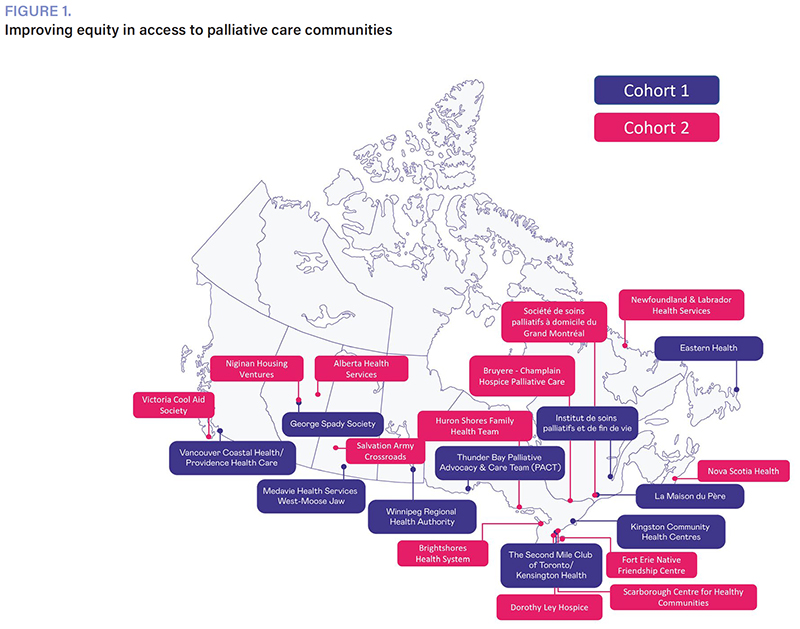
This collaborative was built upon evidence from leading innovative models of equity-oriented palliative care identified through two rapid reviews led by HEC (Bhuiya et al. 2022; Saragosa et al. 2022) and aligned with recommendations set out in the Too Little, Too Late Report (Stajduhar and Mollison 2018). These models emphasized going beyond formal healthcare settings, integrating care into the places where people live and die (Bhuiya et al. 2022; Saragosa et al. 2022).
These communities included a range of health and social care organizations, including but not limited to community health centres, health authorities, organizations that provide care to those experiencing homelessness and Indigenous-led organizations. They represented settings that include urban, rural and remote communities. Several initiatives included partners mandated and funded to provide palliative care.
Participating communities had access to seed funding of up to $100,000, coaching, in-person and virtual learning activities and evaluation support. An “all-teach-all-learn” approach was the foundation of this collaborative with communities engaging in over 150 peer-to-peer knowledge exchange opportunities and consulting with a network of 10 advisers and coaches with subject matter expertise in areas of health equity, culturally safer care, community-based care approaches and collaborating with communities.
The initiatives advanced through IEAPC are diverse, each designed with the strengths, resources and opportunities that exist in each community. The learnings in terms of delivering equity-oriented palliative care are vast (Box 3). They are enhanced by the deep and impactful learning the Program Delivery team has had in terms of the resources, supports and systems required to support improvement on this scale.
| BOX 3. Reframing equitable approaches to care |
|
This initiative might have been one of the most defining moments in my career, really reframing how I view care and equitable approaches to care. I believe that this will continue to follow me regardless of the role I hold – IEAPC Collaborative Team Member |
Purpose of This Special Issue
As we look at the current state of palliative care in Canada, we can reflect on the Framework, Action Plan and the Too Little, Too Late Report as blueprints that outline the structures that enable palliative care provision, clarify the roles and responsibilities of key health system actors and identify opportunities for improvement. To continue progress toward increasing access to more equitable palliative care, it is therefore beneficial to mobilize learnings from the IEAPC implementation journey. These learnings are relevant to audiences in federal-, provincial-, territorial- and community-based health organizations and are transferable across the care continuum.
This special issue features voices from those with lived and living experience, health and social care professionals and team members who work with people experiencing homelessness or vulnerable housing. Each article in this special edition shares unique and important components of this work that, when brought together, demonstrate the complementary nature of interdisciplinary partnership and the strong progress that can arise through innovative collaboration. Readers will be presented with tools, strategies, promising practices, successes and valuable learnings that can be adapted and implemented in jurisdictions across Canada in various care settings to improve health equity for people experiencing homelessness.
Readers will learn about the impact of involving individuals with lived experience in the circle of care and how this role can contribute to overcoming barriers to care, how palliative care programs are delivered and transforming the way systems are designed in communities experiencing homelessness or vulnerable housing (Diner 2026). Recommendations for establishing meaningful and authentic partnerships with First Nations, Inuit and Métis individuals, organizations and communities are also discussed through the lens of culturally safer care (Prince 2026). In addition, as grief and bereavement are often overlooked within the context of homelessness, a dedicated article explores and recognizes the need for specialized grief supports and opportunities for improving the quality of care offered by integrating such supports for clients, providers and community (Black et al. 2026). Where possible, the articles also provide citations to additional sources and tools that may be of interest to the audience.
This gap in care for this population is explored further through a discussion addressing the social determinants of health that drive health outcomes and incorporating innovative trauma-informed and culturally safer approaches to palliative care (Bulle and Dosani 2026). We describe the 23 initiatives that participated in the collaborative and how those models can offer a roadmap for others doing work in equity-oriented palliative care with individuals experiencing homelessness or vulnerable housing (Bulle and Dosani 2026).
We also share evidence and lessons learned from this journey from the 23 participating communities and experts who have been instrumental in the design and implementation of this pan-Canadian collaborative. Over the course of the collaborative, communities shared that they have been able to increase access to equity-oriented palliative care for over 9,000 people, support over 2,000 care providers and provide training to over 3,700 people. Caverley (2026) shares the transformative process of applying a decolonized approach to evaluation practices, specifically the journey, learnings and impact of teams participating in the collaborative that grounded their work in Indigenous communities or around Indigenous practices. Two evaluation articles in this issue expand on how creating, understanding and sharing stories of this collaborative further demonstrates the impact within respective communities experiencing homelessness or vulnerable housing, the collective impact of the collaborative and how this can inform continuous improvement (Caverley 2026; IEAPC Program Delivery Team 2026). The selected articles address prevalent themes and learnings throughout this collaborative around the context of innovative equity-oriented palliative care, including current care inequities and key considerations for healthcare leaders that can inform building a more inclusive and effective healthcare system for those experiencing homelessness or vulnerable housing (Stajduhar 2026).
Conclusion
It is essential that we find new and innovative ways of working together to improve access to healthcare for underserved groups across Canada. This collaborative demonstrated the substantial impact that community-driven interventions that focus on equity as a foundational principle can have in improving the health of individuals and communities.
The articles in this special issue speak to how the challenges, enablers, opportunities, lived and living experiences and unique strengths of this collaborative work can be used as a catalyst for more equitable palliative care across the country.
While we recognize the complexity of the journey to embed equity-oriented approaches, whether in palliative care or in other parts of the healthcare system, we hope this special issue will be a source of inspiration for healthcare leaders as we look to shape a future where everyone has access to safe and high-quality healthcare. We hope you find this information useful and that it encourages you to consider how you can partner and work collaboratively within and across sectors to improve equity in palliative care for everyone in Canada.
Disclaimer
This work is supported by HEC. HEC works with partners across the country to shape a future where everyone in Canada has safe and high-quality healthcare. We bring together people, evidence and action to move Care Forward – spreading and scaling quality and safety improvements, strengthening capacity and collective leadership and catalyzing policy and practice change. HEC is an independent, not-for-profit charity funded primarily by Health Canada. The views expressed herein do not necessarily represent the views of Health Canada.
This work is supported by the Canadian Partnership Against Cancer (the Partnership). As steward of the Canadian Strategy for Cancer Control (the Strategy), the Partnership works with provincial and territorial ministries of health and their cancer programs, First Nations, Inuit and Métis governments and organizations, healthcare system leaders and experts and people affected by cancer across Canada to implement the Strategy to improve cancer outcomes for all people in Canada. The Partnership was created by the federal government in 2006 to move the Strategy into action and receives ongoing funding from Health Canada to continue supporting partners from across Canada. Learn more at partnershipagainstcancer.ca. The views expressed herein do not necessarily represent the views of Health Canada.
About the Author
The Improving Equity in Access to Palliative Care Program Delivery Team includes representatives from Healthcare Excellence Canada (Emilie Desmottes, Amber Heyd, Mihaela Labbe, Kirstin Loates, Tanya MacDonald, Nicole Robinson and Lindsay Yarrow) and Canadian Partnership Against Cancer (Clarissa Chan, Andrea Coronado, Kristen DeCaria and Raquel Shaw Moxam), who have contributed to the strategic development and operationalization of the Improving Equity in Access to Palliative Care pan-Canadian collaborative.
On behalf of HEC and the Partnership, Lindsay Yarrow can be reached by e-mail at ieapc-aeasp@hec-esc.ca or lindsay.yarrow@hec-esc.ca.
*in alphabetical order
Acknowledgment
HEC and the Canadian Partnership Against Cancer (the Partnership) formally acknowledge the generosity of the IEAPC communities, coaches, researchers, patients, clients and family members in sharing their skills, knowledge, expertise and experiences in this special issue. The improvement work happening across the country and the strength of this collaborative are a reflection of their dedication, commitment, passion and expertise.
References
Bhuiya, A., T. Bain, S. Al-Khateeb, S. Soueidan, A. Wang, T. Jarvis et al. 2022, September 1. Rapid Evidence Profile #29.2: What Do We Know From Evidence and Experiences From Other Jurisdictions About Providing Palliative Care for Those Who Are Experiencing or At Risk of Homelessness? McMaster Health Forum. Retrieved August 25, 2026. <https://www.mcmasterforum.org/docs/default-source/product-documents/rapid-evidence-profiles/hec_rep-29.2_palliative-care-for-homeless_report-appendices_2022-09-22.pdf?sfvrsn=b6386a4b_10>.
Black, J., S. Laing, R. Carter, S. Landry, J.R. Graham and E. Hassan. 2026. Grief and Bereavement in the Context of Homelessness: Sharing Experiences and Learnings From British Columbia. Healthcare Quarterly 29(Special Issue): 22–28. doi:10.12927/hcq.2026.27967.
Bulle, S. and N. Dosani. 2026. Reflections on Innovative Models of Palliative Care Delivery. Healthcare Quarterly 29(Special Issue): 29–35. doi:10.12927/hcq.2026.27966.
Canadian Institute for Health Information (CIHI). 2023. Access to Palliative Care in Canada. Retrieved August 25, 2026. <https://www.cihi.ca/sites/default/files/document/access-to-palliative-care-in-canada-2023-report-en.pdf>.
Canadian Observatory on Homelessness. 2012. Canadian Definition of Homelessness Canadian: Observatory on Homelessness. Retrieved August 25, 2026. <https://www.homelesshub.ca/sites/default/files/COHhomelessdefinition.pdf>.
Cancer Care Ontario. 2014. Tools for the Journey, Section B: Palliative Care, Diagnosis and Working Together. Retrieved July 15, 2025. <https://www.cancercareontario.ca/sites/ccocancercare/files/assets/ACCUPalliativeCare.pdf>.
Caverley, N. 2026. Many Paths, Walking Together: Honouring Collective Reflections in Indigenous-Centred Palliative Care in Canada. Healthcare Quarterly 29(Special Issue): 46–56. doi:10.12927/hcq.2026.27964.
Diner, J. 2026. Bridging the Gap: Why Lived Experience Is Essential in Palliative Care for the Unhoused. Healthcare Quarterly 29(Special Issue): 11–14. doi:10.12927/hcq.2026.27969.
Gaetz, S., T. Gulliver and T. Richter. 2014. The State of Homelessness in Canada 2014. The Homeless Hub Press. Retrieved August 25, 2026. <https://homelesshub.ca/wp-content/uploads/2024/04/SOHC2014.pdf>.
Haas, R., F. Brundisini, A. Barbara, N. Darvesh, L. Ritchie, D. MacDougall et al. 2023. Emergency Department Overcrowding: An Environmental Scan of Contributing Factors and a Summary of Systematic Review Evidence on Interventions. Canadian Journal of Health Technologies 3(11): 1–64. doi:10.51731/cjht.2023.786.
Health Canada. 2018, December. Framework on Palliative Care in Canada. Retrieved August 25, 2026. <https://www.canada.ca/content/dam/hc-sc/documents/services/health-care-system/reports-publications/palliative-care/framework-palliative-care-canada/framework-palliative-care-canada.pdf>.
Health Canada. 2019, August. Action Plan on Palliative Care: Building on the Framework on Palliative Care in Canada. Retrieved August 25, 2026. <https://www.canada.ca/content/dam/hc-sc/documents/services/health-care-system/reports-publications/palliative-care/action-plan-palliative-care/action-plan-palliative-care-eng.pdf>.
Health Canada. 2023. The Framework on Palliative Care in Canada – Five Years Later: A Report on the State of Palliative Care in Canada. Retrieved August 25, 2026. <https://www.canada.ca/content/dam/hc-sc/documents/services/publications/health-system-services/framework-palliative-care-five-years-later/final-pdf-english-report-to-parliament-palliative-care.pdf>.
Healthcare Excellence Canada (HEC). n.d. Improving Equity in Access to Palliative Care. Retrieved June 29, 2026. <https://www.healthcareexcellence.ca/en/what-we-do/all-programs/improving-equity-in-access-to-palliative-care/>.
Improving Equity in Access to Palliative Care (IEAPC) Program Delivery Team. 2026. The Power of the Collective: Lessons Learned From Pan-Canadian Efforts to Improve Access to More Equitable Palliative Care. Healthcare Quarterly 29(Special Issue): 36–45. doi:10.12927/hcq.2026.27962.
Prince, H. 2026. Engaging in a Relational Approach: Addressing Inequities in Access to Palliative Care for Indigenous Peoples. Healthcare Quarterly 29(Special Issue): 15–21. doi:10.12927/hcq.2026.27968.
Roerig, M., M. Albert, H. Marani and S. Allin. 2024. Supporting Equitable Access to Health and Social Services for People Experiencing Homelessness in Ontario. North American Observatory on Health Systems and Policies. Rapid Review 44. Retrieved August 25, 2026. <https://naohealthobservatory.ca/wp-content/uploads/2024/08/NAO-Rapid-Review-44_EN.pdf>.
Saragosa, M., M. Morales-Vazquez, M. Roerig, S. Carbone and S. Allin. 2022. Delivering Primary Care in Non-Traditional Healthcare Settings to Individuals Experiencing Homelessness. North American Observatory on Health Systems and Policies. Rapid Review 34. Retrieved August 25, 2026. <https://naohealthobservatory.ca/wp-content/uploads/2022/04/NAO-Rapid-Review-34_EN.pdf>.
St. Michael's Hospital. 2017. Palliative Care Services for People Experiencing Homelessness in Toronto: A Preliminary Needs Assessment. Retrieved August 25, 2026. <https://icha-toronto.ca/sites/default/files/TC%20LHIN%20REPORT%20Pall%20Care%20Services%20for%20Homeless%20Needs%20Assess%20May%202017.pdf>.
Stajduhar, K. and M. Gott. 2023. Closing the Health Equity Gap in Palliative Care: The Time for Action Is Now. Palliative Medicine 37(4): 424–25. doi:10.1177/02692163231164729.
Stajduhar, K. I. 2026. What Leaders Need to Know About the Design and Delivery of Equity-Oriented Palliative Care. Healthcare Quarterly 29(Special Issue): 57–62. doi:10.12927/hcq.2026.27963.
Stajduhar, K.I., M. Giesbrecht, A. Mollison, K. Whitlock, P. Burek, F. Black et al. 2024. “You Can't Die Here”: An Exploration of the Barriers to Dying-in-Place for Structurally Vulnerable Populations in an Urban Centre in British Columbia, Canada. BMC Palliative Care 23(1): 12. doi:10.1186/s12904-024-01340-7.
Stajduhar, K.I. and A. Mollison. 2018. Too Little, Too Late: How We Fail Vulnerable Canadians as They Die and What to Do About It. University of Victoria Institute on Aging and Lifelong Health. Retrieved August 25, 2026. <https://www.uvic.ca/research/groups/palliative/assets/docs/publications/report-too-little-too-late.pdf>.
Stajduhar, K.I., A. Mollison, M. Giesbrecht, R. McNeil, B. Pauly, S. Reimer-Kirkham et al. 2019. “Just Too Busy Living in the Moment and Surviving”: Barriers to Accessing Health Care for Structurally Vulnerable Populations at End-of-Life. BMC Palliative Care 18(1): 11. doi:10.1186/s12904-019-0396-7.
Toronto Public Health. 2025, February 3. Toronto Public Health Releases Updated Data for Deaths of People Experiencing Homelessness in Toronto [Press Release]. Retrieved July 3, 2025. <https://www.toronto.ca/news/toronto-public-health-releases-updated-data-for-deaths-of-people-experiencing-homelessness-in-toronto/>.
World Health Organization (WHO). 2020. Health Impact Assessment. Retrieved August 12, 2025. <https://www.who.int/europe/health-topics/health-impact-assessment#tab=tab_1>.
Comments
Be the first to comment on this!
You must sign in to comment Sign In or Create an Account to add comments
Related Content
Healthcare Quarterly
Healthcare Quarterly
Evaluating the Patient Family Advisor Experience in Patient Oriented Research
HealthcarePapers
Equity-Driven and Community Empowerment-Focused Social Prescribing: Lessons from the Front Lines