


Nursing Leadership
The Canadian Nurses Association Today: Advancing Nursing Leadership and Health System Transformation Through Five Professional Domains
Abstract
The Canadian Nurses Association (CNA) plays a critical role in advancing nursing leadership and health system transformation across Canada. Guided by five strategic directions and operationalized through five interconnected professional domains – policy, practice, research, leadership and education – CNA has strengthened nursing's influence on health policy, workforce sustainability, quality care, leadership development and lifelong learning. This article highlights key accomplishments from 2024 to 2026, including policy advocacy, implementation of the updated code of ethics, expansion of specialty certification and workplace excellence initiatives, advancement of nursing research and knowledge mobilization and development of national leadership capacity. As Canada's health system faces increasing fiscal, workforce and structural pressures, CNA's integrated approach demonstrates how coordinated national nursing leadership can drive innovation, improve health outcomes, strengthen the profession and support sustainable system transformation.
Introduction
The Canadian Nurses Association (CNA) exists to make nursing better – for nurses, for patients and for Canada's public health systems. Guided by a vision of progressive leadership since 1908 that unites nurses to advance the profession, the health of Canadians and a healthier environment and society, CNA continues to amplify its national role as the professional voice of nursing in Canada (CNA 2023).
CNA's position is clear: meaningful health system transformation cannot occur without fully leveraging the leadership, expertise and power of nurses – the country's largest group of regulated health professionals. Regulated nurses are uniquely positioned to improve quality, strengthen access, lead promotion and prevention, optimize care delivery and help “bend the cost curve” while improving patient and population health outcomes (Grdisa 2025a).
CNA's five strategic directions – fiscal and operational stability, strong nursing leadership identity, meaningful member engagement, inclusion of nurses' voices in policy decisions and innovation in expanded nursing practice – provided the structural foundation for operationalizing our work over the past three years. Since summer 2024, when I joined CNA, I have had countless conversations with CNA members, longstanding partners and the broader nursing community explaining how the five interconnected overarching professional domains – policy, practice, research, leadership and education – translate CNA's strategic directions into national action. These domains are not independent streams of work; they are intentionally aligned levers that connect organizational activity to system-level outcomes, ensuring that nursing leadership is consistently embedded in every decision, action and impact and that CNA members have countless ways to contribute.
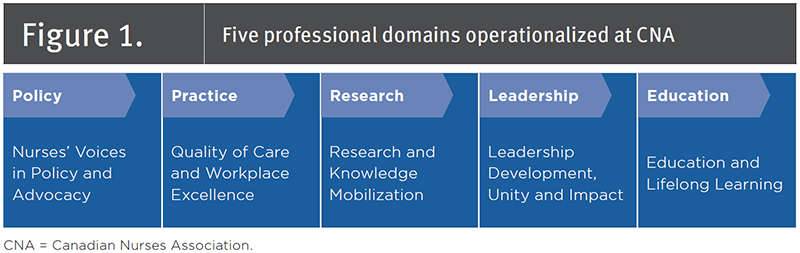
Across each domain, CNA's accomplishments demonstrate how the strategic directions are being advanced and how they collectively respond to one of the most urgent realities in Canadian healthcare: a system under growing fiscal, workforce and structural pressure that requires coordinated transformation rather than incremental adjustment. We need every CNA member, every voice of every nurse from coast to coast to coast and every nursing ally and partner, to achieve our mission. The contributions of the CNA board of directors, council members, other steering committee members, Fellows of the Canadian Academy of Nursing, Canadian Network of Nursing Specialties (CNNS) affiliates, subject matter experts, invested partners, sponsors and vendors are critical to ensuring that CNA is leading the way for another century – in collaboration with CNA's operational team – which is small in full-time employee positions, but substantive in focus and finish by domain.
Policy Domain: Nurses' Voices in Policy and Advocacy
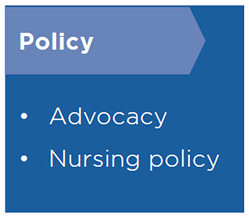
This domain directly advances the CNA's priority to ensure that nurses' voices are embedded in all levels of policy decision making. In 2025, CNA engaged in approximately 95 meetings with federal, provincial and territorial policy makers and continues to demonstrate how nurses and nurse practitioners stand ready to partner with federal leaders to implement bold reforms, drive innovation and improve outcomes for all. These engagements reflect CNA's role as the only national nursing association (NNA) representing the profession at the federal level as the sole NNA member of the International Council of Nurses.
This domain also reflects CNA's commitment to fiscal and operational stability in the broader health system. Through its Policy Roadmap (CNA 2026a) and the 2026 pre-budget submission (CNA 2026b), CNA advanced five priority areas and 24 policy imperatives aimed at improving patient experience and outcomes, optimizing the nursing workforce to realize our true value, investing in the health, safety and well-being of the health workforce, strengthening public health capacity and driving systemic strategies and solutions. These efforts are grounded in the recognition that Canada's health expenditures – reaching $400 billion annually (12.7% gross domestic product) in 2025 (CIHI 2026) – are not translating into proportional gains in access, quality or sustainability.
Key policy accomplishments include national leadership on labour mobility and regulatory harmonization (specifically focused on internationally educated nurses), Indigenous health and reconciliation initiatives, harm reduction, advanced technologies (i.e., artificial intelligence), planetary health policy development and advocacy for strengthened workplace protections. CNA's 75 media engagements in 2025 further extended these policy positions into the public domain, reinforcing nursing's role in shaping evidence-informed national dialogue. In 2026, we will continue our policy priorities in our advocacy efforts, such as introducing new or updating our position statements on harm reduction, mis/disinformation and medical assistance in dying. Also, we launched CNA's reconciliation framework in June 2026 to guide our profession toward providing safer care and actioning reconciliation (CNA 2026c).
Practice Domain: Quality of Care and Workplace Excellence

This domain is directly aligned with CNA's priority of innovation and expanded nursing practice, as well as strengthening nursing leadership identity. This domain focuses on improving outcomes (patient, nursing, team, organizational, system), integrating the CNA code of ethics, evaluating workplace settings (acute care and long-term care) and valuing nursing expertise, including recognizing and rewarding specialized knowledge and skills.
The CNNS, composed of 35+ affiliates of specialty nursing associations and interest groups, represents a key mechanism through which CNA advances coordinated practice leadership across diverse clinical areas (CNA 2026d, Grdisa 2025b). In 2025, CNNS's work in collaboration with CNA strengthened its role in informing national policy, amplified the impact of specialty nursing practice and contributed to national policy and system transformation initiatives. Notably, several CNNS affiliates are serving on the 2026 CNA conference planning committee.
The July 2025 release of the updated CNA Code of Ethics for Nurses (CNA 2025) provides clear, contemporary guidance grounded in respect, equity, cultural safety and social justice, supporting nurses as they navigate complex ethical situations, while aligning ethical leadership with system expectations. From July to December 2025, there were 295,464 total combined views and 384,840 total user views.
A major milestone within this domain is the scaling up of the Stellar certification program (CNA 2026e), launched in 2024, which evaluates and certifies organizations based on six pillars of workplace excellence: nursing voice, leadership excellence, education and career progression, resourcing, practice environment and optimization of care. This initiative directly supports CNA's strategic priority of fiscal and operational stability by improving retention, reducing inefficiencies and strengthening workforce sustainability through healthier and high-performing work environments.
In 2026, six new organizations started their Stellar certification journey, and we will continue our practice initiatives in collaboration with the CNNS affiliates and other partners to develop relevant practice-based scenarios based on the code of ethics. Finally, we will be releasing the second edition of The Landscape of Regulated Nursing in Canada: 2026 – to better understand the structures that shape nursing practice and the four regulated nursing designations – not as competitors within a hierarchy, but as distinct and complementary professionals whose combined expertise is essential to achieving the Quintuple Aims. And understanding that fragmentation among employers, regulators, professional associations, educational institutions and unions – however well-intentioned – carries real consequences for patients, providers and the public.
Research: Research and Knowledge Mobilization

This domain directly supports CNA's priorities of innovation, leadership identity and ensuring nurses' voices influence policy decisions. CNA does not function as a primary research producer; rather, it serves as a national knowledge mobilizer, collaborator and principal knowledge user in research that informs system transformation.
Through partnerships with federal granting agencies, universities and colleges and national health organizations, CNA contributed to research spanning workforce sustainability, Indigenous health, anti-racism, mental health, digital health and health system innovation. CNA's co-leadership of the Centre for Research on Health and Nursing with the University of Ottawa reflects its commitment to strengthening national capacity for applied nursing research and policy translation.
Knowledge mobilization is further enabled through the Canadian Nurse journal, one of the longest-standing nursing publications in Canada, which continues to amplify evidence-informed practice, innovation and leadership perspectives across the profession. Notably, CNA has had a longstanding relationship with Longwoods and a benefit for CNA's premium membership is free access to the Canadian Journal of Nursing Leadership.
In 2026, CNA's advancement of national nursing data standards in collaboration with Canadian Institute for Health Information and Canada Health Infoway, including work related to Canadian Health Outcomes for Better Information and Care and digital health partnerships, continues to strengthen the visibility of nursing contributions in system-level planning and reinforces the evidence base required for workforce optimization and policy reform (Grdisa 2025c). CNA will also be releasing the Canadian Institutes of Health Research-funded landmark report, The Dangers Within: Unravelling Discrimination Among Nurses in Canada, and promoting the short documentary film developed to accompany this report – No Safe Shift: Unravelling Discrimination Among Nurses in Canada.
Leadership: Leadership Development, Unity and Impact
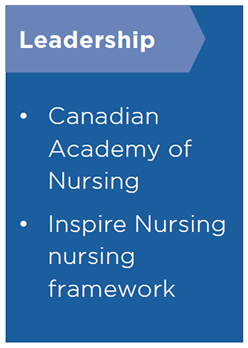
The leadership development domain directly advances CNA's strategic priority of strengthening nursing leadership identity and presence, while also reinforcing meaningful member engagement.
The Canadian Academy of Nursing, established in 2020, has grown into a national leadership platform with more than 730 members, including Fellows (CNA 2026f). Through expert panels, mentorship and national dialogue, Fellows contribute substantively to shaping the profession across all domains and have a major footprint in health system transformation (past, present and future).
The Inspire Nursing Leadership Program further operationalizes leadership development by building competencies aligned with the Dorothy Wylie Health Leadership Institute and the Canadian College of Health Leaders LEADS framework. This program strengthens system-level leadership capacity, equipping nurses to navigate complexity, lead innovation and drive organizational and policy change.
CNA's leadership presence is further reinforced through participation on national and international boards and advisory bodies, ensuring alignment between nursing leadership development and broader health system governance.
Together, these initiatives strengthen professional unity at a time when membership is no longer structurally guaranteed, making leadership engagement essential to sustaining a coherent and influential national nursing voice. In 2026, CNA is unifying the nursing community by hosting its first conference in eight years, The Power of Nurses to Transform Health – Our Expertise, Our Impacts. We received 385 abstracts and after a rigorous blind review process, more than 220 presentations are planned in four different methods. Also, CNA is developing a leadership development program for early career nurses that responds to CNA members' feedback and addresses gaps in core leadership capabilities.
Education: Education and Lifelong Learning
This domain directly supports CNA's strategic priorities related to innovation in nursing practice, fiscal sustainability and strengthening workforce capacity. CNA's Specialty Certification Program, established in 1992, remains a cornerstone of specialty nursing practice competencies in Canada and currently serves as CNA's top revenue source. With 23 specialties and 19 examinations across nursing categories, the program continues to support lifelong professional development and credential recognition of advanced practice expertise.
In 2025, more than 918 nurses achieved new certification, while 1,260 maintained certification through renewal, contributing to more than 11,000 CNA-certified nurses. The expansion of portfolio-based certification pathways – including forensic nursing, trauma nursing and foot care – reflects CNA's commitment to modernizing credentialing models and aligning education with evolving health system needs. The certification leadership pathway linked to the (International Nurses Licensure Pathway) further integrates education and leadership development, reinforcing CNA's commitment to continuous professional growth across the career span.
CNA's Accreditation Program ensures that continuing education offerings meet high standards of quality, evidence and relevance. With more than 50 accredited courses and ongoing program expansion, CNA strengthens lifelong learning opportunities that directly contribute to improved care quality and workforce readiness.
In 2026, the CNA team is working closely with the subject matter experts and CNNS affiliates that support the specialty certification to continue examination renewal and to expand specialty certification to international markets. A modernized technology solution is currently being designed for the accreditation programs and will be implemented in the coming months. Finally, CNA continues to provide membership engagement and professional development opportunities focused on issues that matter to our members, and on June 19, CNA launched its reconciliation framework with planned actions.
Looking Ahead: A Critical Juncture for Nursing and the Health System
Canada's health system is at a defining inflection point. Rising costs, workforce instability, increasing care complexity and persistent inequities signal a system that is under sustained pressure and no longer aligned with population health needs or workforce realities. At the same time, these pressures create an urgent opportunity for redesign – one that fully leverages the expertise, leadership and system-wide influence of nurses.
Within this context, CNA's role is not optional; it is essential. As membership is now a matter of individual choice rather than automatic affiliation through licensure, the collective strength of the profession can no longer be assumed. It must be actively built, reinforced and sustained (Grdisa 2026). CNA, together with provincial and territorial nursing associations, remains one of the only coordinated national structures dedicated to advancing, protecting and strengthening the nursing profession at a system level.
This reality reinforces both a challenge and an opportunity: without strong national coordination, nursing influence risks fragmentation at precisely the moment when system transformation demands unity. With it, nursing has the capacity to lead one of the most significant health system redesign efforts in Canada's history.
Looking forward, CNA will continue to advance a unified, evidence-informed agenda across its five domains – connecting policy, practice, research, leadership and education into a coherent national strategy for system transformation. This includes workforce optimization, regulatory harmonization, strengthened workplace environments, expanded leadership capacity, enhanced knowledge mobilization and modernized education pathways and credentialing centre programs.
Critically, the next phase of work must also be shaped by renewed engagement from nurses across Canada. The 2026–2030 strategic planning process represents a pivotal opportunity for the profession to define its collective future – clarifying priorities, strengthening alignment and ensuring that nursing leadership remains central to health system reform. Re-engagement is not simply participation; it is co-ownership of the profession's future direction in a rapidly changing system.
Our future will require bold thinking, disciplined execution and sustained collaboration. It will require confronting uncomfortable truths about system capacity, workforce strain and structural inefficiencies. But it will also require optimism grounded in evidence: the belief that better models of care are possible, that nurses are central to designing them and that coordinated national leadership can drive meaningful, lasting change.
At its core, CNA's work reflects a simple but powerful belief: healthier nurses, stronger nursing leadership and better-supported practice environments lead to healthier people, healthier communities and a healthier Canada.
Please join CNA or get active, contribute to our strategic planning process and ultimately our future – we represent half a million people or one in 57 voters, we have the power!
Correspondence may be directed to Valerie Grdisa by e-mail at executiveoffice@cna-aiic.ca.
About the Author(s)
Valerie Grdisa, RN, Phd, Chief Executive Officer, Canadian Nurses Association, Ottawa, ON
References
Canadian Institute for Health Information (CIHI). 2026. National Health Expenditure Trends. Retrieved May 20, 2026. <https://www.cihi.ca/en/national-health-expenditure-trends>.
Canadian Nurses Association (CNA). 2023. CNA Strategic Plan 2023–2026. Retrieved May 25, 2026. <https://hl-prod-ca-oc-download.s3-ca-central-1.amazonaws.com/CNA/2f975e7e-4a40-45ca-863c-5ebf0a138d5e/UploadedImages/documents/Public_CNA_Strategic_Plan_2023-2026.pdf>.
Canadian Nurses Association (CNA). 2025. Code of Ethics for Nurses. Retrieved May 21, 2026. <https://www.cna-aiic.ca/en/nursing/regulated-nursing-in-canada/nursing-ethics>.
Canadian Nurses Association (CNA). 2026a. CNA's Policy Roadmap for 2025 and Beyond. Retrieved May 1, 2026. <https://www.canadian-nurse.com/en/policy-advocacy/policy-roadmap>.
Canadian Nurses Association (CNA). 2026b, April. Submission for the Pre-Budget Consultations in Advance of the Fall 2026 Federal Budget. Retrieved May 25, 2026. <https://hl-prod-ca-oc-download.s3-ca-central-1.amazonaws.com/CNA/2f975e7e-4a40-45ca-863c-5ebf0a138d5e/UploadedImages/documents/policy-advocacy/2026-Pre-Budget-Submission_May-2026_EN.pdf>.
Canadian Nurses Association (CNA). 2026c, June 19. CNA's Reconciliation Framework Launch. Retrieved May 20, 2026. <https://www.cna-aiic.ca/events/event-description?CalendarEventKey=aca1d12d-9149-4c3a-a42e-019e009f241c&Home=%2fen%2fnews-events%2fupcoming-events>.
Canadian Nurses Association (CNA). 2026d. Canadian Network of Nursing Specialties. Retrieved May 22, 2026. <https://www.cna-aiic.ca/en/membership/canadian-network-of-nursing-specialties>.
Canadian Nurses Association (CNA). 2026e. Stellar Certification Program. Retrieved May 15, 2026. <https://www.cna-aiic.ca/en/stellar/what-is-stellar>.
Canadian Nurses Association (CNA). 2026f. About the Academy. Retrieved April 30, 2026. <https://www.cna-aiic.ca/en/academy/about-the-academy>.
Grdisa, V. 2025a. Embracing the Full Spectrum of Nursing Leadership: A Unified Call to Action for Canada's Health System Transformation. Canadian Journal of Nursing Leadership 37(4): 8–12. doi:10.12927/cjnl.2025.27613.
Grdisa, V. 2025b. Championing Specialty Nursing Certification: A Call to Action for Canadian Nurse Executives. Canadian Journal of Nursing Leadership 38(1): 7–14. doi:10.12927/cjnl.2025.27660.
Grdisa, V. 2025c. Commentary: It Is Now and We Need to Unite as One Profession and Drive the Data Structures for the Future. Canadian Journal of Nursing Leadership 37(4): 25–28. doi:10.12927/cjnl.2025.27611.
Grdisa, V. 2026. Reflections on the Evolving Purpose and Power of Nursing Associations in Canada. Canadian Journal of Nursing Leadership 38(3): 100–08. doi:10.12927/cjnl.2026.27783.
Comments
Be the first to comment on this!
Personal Subscriber? Sign In
Related Articles


Note: Please enter a display name. Your email address will not be publically displayed